
When Africa Writes Itself
By Taslym Umar

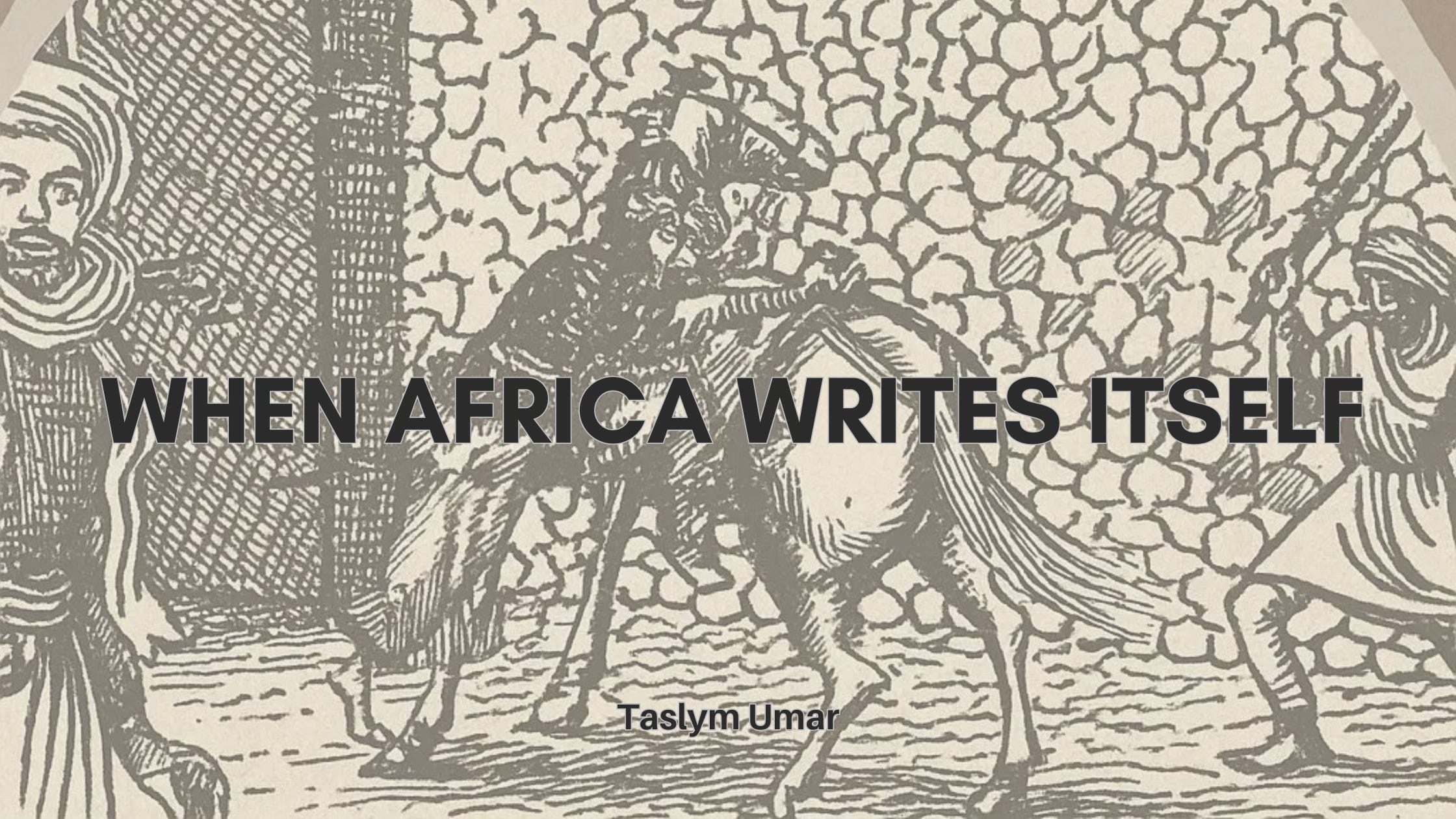
It is one of history’s ironies that Gandoki, one of the earliest Hausa novels, was written for a competition organized by Rupert East, a British colonial officer. The contest was meant to “encourage” African writing, yet the novel that emerged was anything but obedient. Gandoki tells the story of a man who rises against colonial forces, challenging the very system that created the prize. What could be more rebellious than using the colonizer’s paper and ink to write against him? From the beginning, African literature was never a polite guest. It was defiance bound in paper.
That defiance lived in quieter spaces, too. In Kano, I first discovered stacks of Hausa novels in the rooms of married women. Perfume-scented pages were tucked under pillows, hidden in cupboards, rented for twenty or thirty naira the same way people rented movies. They were not just leisure. They were surviving. Women who might never touch an English novel could imagine love, betrayal, even desire in a deeply conservative society. In their hands, pulp romance became a revolution.
These novels were more than entertainment. They questioned forced marriage, poverty, and patriarchy. They gave women a private arena to imagine different futures, even when the world outside demanded silence. Soyayya novels, often dismissed as pulp romance, were anything but trivial. In a society where women were expected to suppress their voices, they wrote openly of love, choice, and longing in a language the world said was too provincial. To write such things in Hausa, in public, was rebellion. Soyayya was as political as Gandoki.
This tension is not unique to Nigeria. Across the continent, the pattern repeated. Writers used literature to resist erasure in whatever form it came. Alex La Guma stripped apartheid bare. Ngũgĩ wa Thiong’o abandoned English entirely, proving African languages carried their own cosmos. Nawal El Saadawi wrote herself into prison because she dared to tell the truth about women’s lives in Egypt. They did not beg for permission. They wrote to disrupt.
To write from Africa has always been to write with a double consciousness. You are crafting sentences while deciding how much of your culture to reveal, how much to guard, and how not to be exoticized. When I first stumbled into English books, I thought I was entering a new world. I soon discovered it was a world designed to suggest mine was not enough. Yet the writers before me proved otherwise. They showed that carrying one’s culture into writing is not a burden. It is power.
But here is the danger. Today, much of African literature feels too careful, too tailored for prize committees and festival stages abroad. Too many writers polish their voices until they sound universal, which is just another word for Western. Joy, desire, and ordinary domestic life are still treated as trivial, unless framed as trauma for export. Instead of rebellion, we are seeing performance.
The Soyayya novels remind us of another path. For a woman in Kano, a rented love story could be more radical than a political tract. Oral tales like my grandmother’s stories of Gizo da Koki carried the wisdom of entire communities, disguised as play. These were not written for London or New York. They were written for us, and that was enough.
African literature does not need to prove itself. It has already rewritten the map. From Hausa to Gikuyu to Arabic, the message is clear: our stories are not waiting for validation, they are already alive, already loud. The real task now is to resist a quieter kind of colonization — the temptation to write what the West rewards instead of what Africa needs.
The continent is often overlooked, yes, but worse, it is being misrepresented. It is time for African writers to stop curating themselves for the world and start writing for themselves again. Because when Africa writes itself, it is not just literature. It is survival, rebellion, and truth.